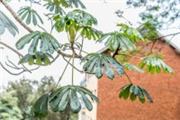
Musanga cecropioides
Corkwood, Umbrella tree
Kwamba: Kigere, kikumbu Luganda: kaliba, namagulu.
Description
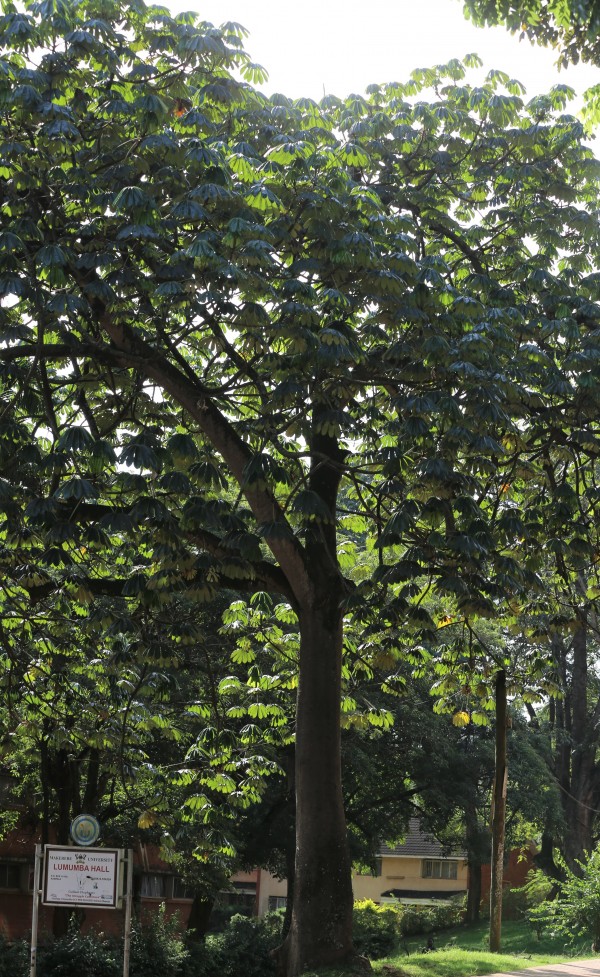
A deciduous tree to 30 m with a straight bole, often with prop roots at the base, sometimes entirely supporting the tree. Branches arise at an angle towards the top of the trunk thus making a fine umbrella crown only one leaf thick.
BARK: thin, pale grey, with ring marks and corky outgrowths, underbark green-grey. Broken branches, -soft and pithy, exude a lot of watery sap which can be drunk.
LEAVES: compound, palmate to 110 cm across with 11-25 shiny green leaflets, each to 45 cm long on a hairy leaf stalk to 60 cm. Lower surface white hairy. Leafy stipules at base of stalk red-brown and hairy to 30 cm long.
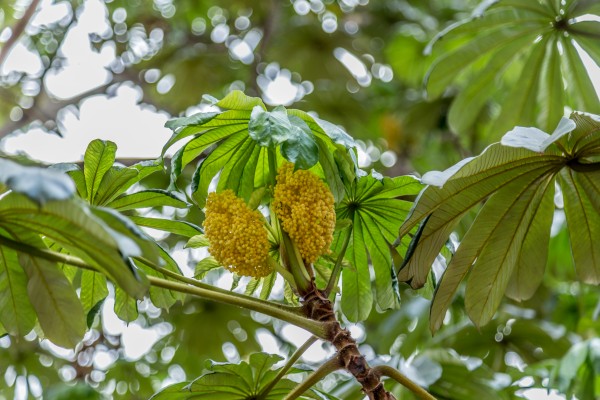
FLOWERS: male trees have branched stalks about 10 cm with more than 50 round pink stamen heads. Female trees usually have pairs of yellow green succulent flower heads 2-3 cm long on a 12-cm stalk. Both flower heads are protected by large hairy red bracts.
FRUIT: The female head ripens to a fruiting head about 12 cm long, green and fleshy, each fruit separate, containing the tiny seeds.
Uses
Edible: bark scrapings are added to fermenting sugar-cane sap to increase the potency, wood-ash from freshly felled trees provides a vegetable salt for use in cooking, stems are source of impromptu drink, bark shavings are added as intoxicants in the preparation of palm wine. http://tropical.theferns.info/viewtropical.php id=Musanga+cecropioides , http://www.worldagroforestry.org/treedb/AFTPDFS/Musanga_cecropioides.PDF
Medicine: bark, roots, leaves, inflorescence buds, sap expressed from the bud, hairs from the inside of the stipule, catkins. http://tropical.theferns.info/viewtropical.php id=Musanga+cecropioides
Agroforestry: tree canopy produces a dense leaf-litter which creates a heavy layer of humus, sometimes used as a shade plant for coffee plantations, nitrogen fixation, provides fodder especially the fruits to animals.
The wood is used as a cork substitute. Its extreme lightness lends itself to make fishing-net floats and rafts.
Wood-ash from freshly felled trees provides a lye for soap-making.
The sap that turns black due to exposure to air can be used as ink.
The sap from the stilt roots is used to produce a protective film on earthenware pots.
Long strong fibers extracted from the bark can be bleached and turned into a resistant paper, or made into twin.
The wood is sometimes used as firewood, though it is of low quality.
Provides timber. The wood is used for making palings for enclosing compounds and fields, rough partitions in temporary huts, shingles for interior lining of roofs having an insulating effect, for domestic articles such as stools, musical instruments, walking-sticks, trays, baskets, toy popguns, etc. It has been used to float heavy bridging timbers to inaccessible river-bank sites. Larger trunks are used to fashion out canoes and dugouts, long drums and blacksmith's bellows.
The wood yields a strong paper and has found recommendation as pulp.
An ornamental tree.
Ecology
Corkwood is native to Uganda. A typical secondary-forest tree, easy to recognize, extending into Angola and west to Senegal. Dormant seeds germinate in large quantities when an open space appears in closed forest. It cannot tolerate shade and would normally die after about 20 years in natural forest. In Uganda, it grows chiefly in secondary forests and at forest edges, preferring river banks and wet places near the western shores of Lake Victoria. In Kampala, Corkwood can be found within Makerere University, Makerere II Zone C among other places.
Management
Fast growing but short lived; pollarding. Thin young seedlings after broadcasting.
Tree gallery