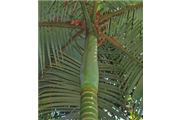

Ficus natalensis
Bark-cloth fig, Natal fig, Common wild fig, Strangler fig
Luganda:Mutuba Lugwere: Tera Luo J: Kiditi Lusoga: Mugaire, kiryanyonyi Runyankore:Mutooma, ekitooma.
Description
An evergreen shrub or tree usually 12 m but up to 30 m with upright branches to a dense drooping crown. Aerial roots may hang down from the branches and the base of the trunk is often a mass of interwoven roots.
BARK: pale grey, thin and smooth.
LEAVES: rather stiff, long oval, often wider at the tip, about 6 cm (2.5-10 cm) long, tip rounded or shortly pointed, 5-10 veins on either side, on a stalk 0.5-2.0 cm long.
FLOWERS: enclosed within figs.
FIGS: in pairs beside or just below leaves on stalks 2-10 mm, rounded yellow-red when ripe 8-18 mm across, 2 mm long, bracts at the base fall off (unlike F. tbonningii ).
Uses
Medicine: bark, roots, leaves, root pulp, sap squeezed from the aerial roots, leaf sap. http://tropical.theferns.info/viewtropical.php id=Ficus+natalensis , https://www.prota4u.org/database/protav8.asp g=pe&p=Ficus+natalensis+Hochst
A fiber is obtained from the bark and is used to make cloth, paper and as material for the bookbinder.
Agroforestry: can be planted as a living fence or hedges, cultivated as a shade tree in coffee plantations, leaves are given to domestic animals as fodder, used as a shade tree in coffee, cocoa, and banana plantations.
It is also used as landmark.
The wood is used to carve household utensils, as house-posts.
Provides firewood.
The soft wood can be used to make 'fire sticks'.
The latex is used as glue and bird-lime.
Ficus natalensis can be grown as a bonsai plant.
An ornamental tree.
Edible: dried and pounded fruits are mixed with cassava flour to make bread. https://www.prota4u.org/database/protav8.asp g=pe&p=Ficus+natalensis+Hochst
Ecology
Bark-cloth fig is indigenous to Uganda. A common African fig tree found from West to East, northern Zambia to South Africa. It grows in both wet and dry forest and thickets, in riverine and ground-water forests in higher rainfall woodland and savanna, 10-2,200 m. The tree has been cultivated in all regions of Uganda. It often begins life as an epiphyte then becomes a strangler and replaces the host tree, but may also be quite terrestrial. In Kampala, Bark-cloth fig can be found within Makerere university, Uganda Golf course club, at Nakasero hill road, Lower Kololo terrace among other places.
Management
Fast growing.
Tree gallery
.jpg)
.jpg)
.jpg)
.jpg)