Pinus patula
Mexican weeping pine, Spreading-leaved pine, Tecote pine
Description
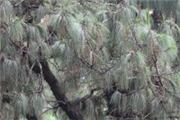
An evergreen tree to 35 m with light green, weeping foliage and a long straight trunk; branches more or less horizontal, turning up at the tips.
BARK: grey to dark brown, fairly smooth, papery red-brown on young branches.
LEAVES: long slender "needles", soft but hard tipped, 15-23 cm long, in bundles of 3.
FLOWERS: male and female flowers produced separately on the same tree. Male flowers on the upper part of branchlets, female on the lower part.
FRUIT: cones, female: small hard red spheres mature in 2 years to shiny brown cones, base oblique, to 10 cm long in clusters of 2-5 without stalks. Male: on the same tree, short terminal catkins, yellow-brown, producing clouds of dust-like pollen. Seeds develop below the cone scales and are released over a long period.
Uses
Edible: a vanillin flavoring is obtained as a by-product of other resins that are released from the pulpwood. http://tropical.theferns.info/viewtropical.php id=Pinus+patula
Medicine: Resin. http://tropical.theferns.info/viewtropical.php id=Pinus+patula
Agroforestry: suitable for the reclamation of gullies, as the thick mat of fallen branchlets and needles retards surface run-off, limiting the advance of soil erosion, can be planted as a windbreak.
A tan or green dye is obtained from the needles.
Rosin can be used by violinists on their bows and also in making sealing wax, varnish. http://tropical.theferns.info/viewtropical.php id=Pinus+patula
Pitch can also be obtained from the resin and is used for waterproofing, as a wood preservative etc.
Provides timber. The wood of young trees can be used to manufacture boxes, and that of older trees for light construction, light flooring, joinery, ceilings, panelling, shingles, furniture, cabinet work, fence posts, poles, food containers, pallets, mine props, veneer and plywood.
It is an important source of pulpwood.
The wood provides fuel, and is also used for the production of charcoal.
It provides poles or posts.
Ecology
Pinus patula is native to Mexico. Probably the most widely planted pine in tropical Africa. It is tolerant of most soils and will grow in grassland. It grows best with good water supplies but can also survive adverse conditions. It grows best at higher altitudes: above 1000 m at 18 30 latitude, and above 2000 m near the equator; several provenances tolerate severe frost. In Uganda, it does well at higher elevations but at lower elevations does not produce cones. In Kampala, this pine can be found within Makerere university, Uganda Golf course club, along Kintu road among other places.
Management
Fast growing. During the first year after planting out 2 3 weeding operations are required. It also requires pruning, and thinning depending on initial spacing.
Tree gallery
.jpg)
.jpg)
.jpg)