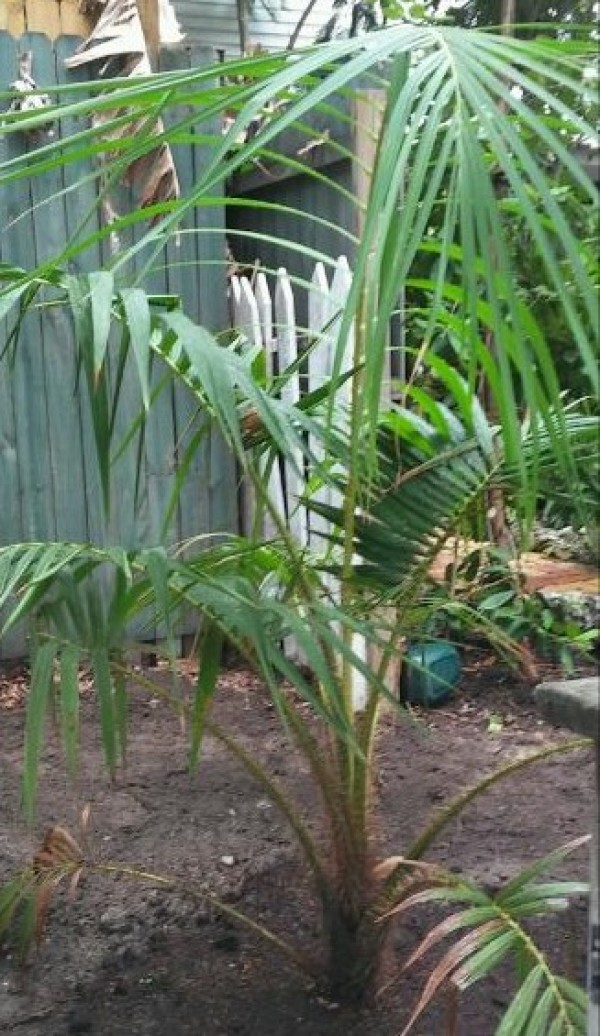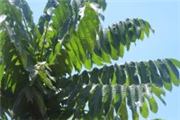
Pigafetta filaris
Wanga palm, White wanga palm, Papua New Guinea palm, Papua New Guinea Pigafetta palm, Pigafetta palm
Description
Wanga palm is a single-stemmed, evergreen palm tree that can reach a height of 50 meters and a diameter of 30-45 cm.
BARK: glossy green for a good part of its length, tending to the brown in the oldest part, and ringed with the scars of the old leaves. It has often a mass of adventitious roots at the base.
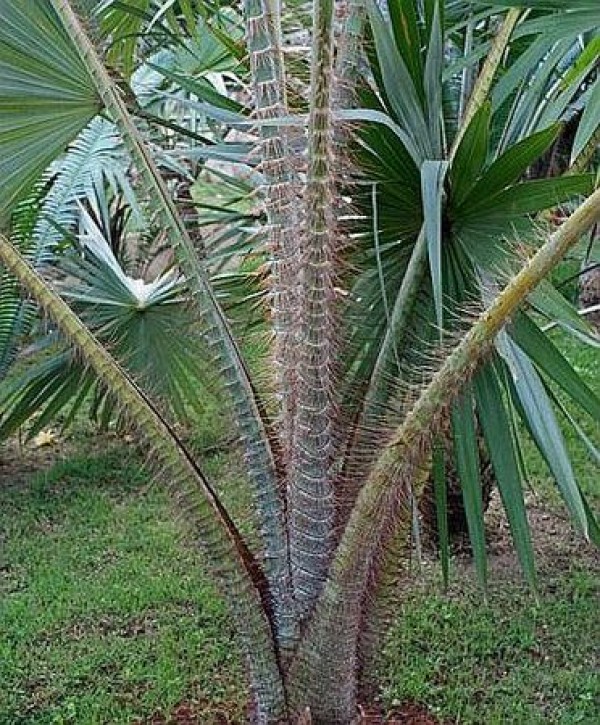
LEAVES: pinnate up to 6 m long, arching. Petioles robust, about 1,8 m long, grey-green covered by a white powder with base not completely surrounding the stem and very spiny, the spines are pale yellow, flexible, about 7 cm long and arranged in slightly undulate linear jagged rows. Leaflets dark green long, thin and acuminate, about 1 m long and slightly pendulous, with short bristles at the margins and along the central nervature. Regularly inserted along the rachis and forming a V.
FLOWERS: axillary, similar in the feminine as well as in the masculine plants, pale yellow, about 2 m long. Peduncle and rachis disposed horizontally with pendulous floriferous branches.
FRUITS: small ovoid, about 1,2 cm long, covered by imbricate yellow to orange scales and contain one seed only.
Uses
Edible: fruit is occasionally eaten.
Agroforestry: can be used as a pioneer species, especially for re-establishing native woodland.
A fiber obtained from the young leaves is used for making thread.
The leaves are made into small rugs.
The wood is very hard and used extensively for construction.
An ornamental palm
Ecology
Wanga palm is indigenous to New Guinea and the Moluccas, in Indonesia. It is an over-storey palm found in wet disturbed forests on lavas, banks of water streams and margins of the forests. It is one of the very few strictly secondary forest palms. It occurs at forest edges and disturbed land at elevations of 300 - 1,500 meters. rapidly colonizes forest clearings and other situations in full light. In Kampala, Wanga palm can be found along Kanjokya street, Nasser road among other places.
Management
Fast-growing. Prune diseased, damaged or drying fronds, but do not prune if the frond still has some green color.
Tree gallery
.jpg)