Morinda lucida
Brimstone tree
Kwamba: Mukiringi Luganda: Mubajansayi Lugwe: Musinganjovu Lusoga: Mulyambwa
Description
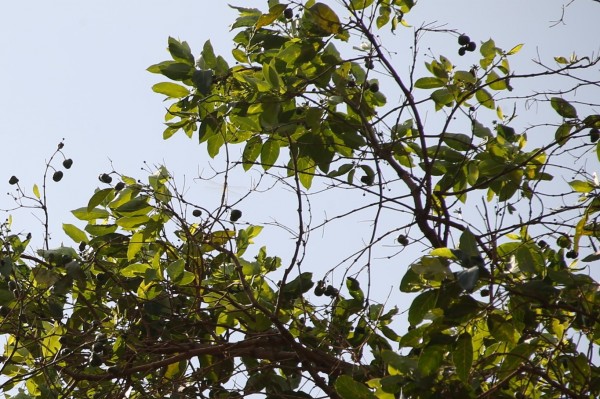
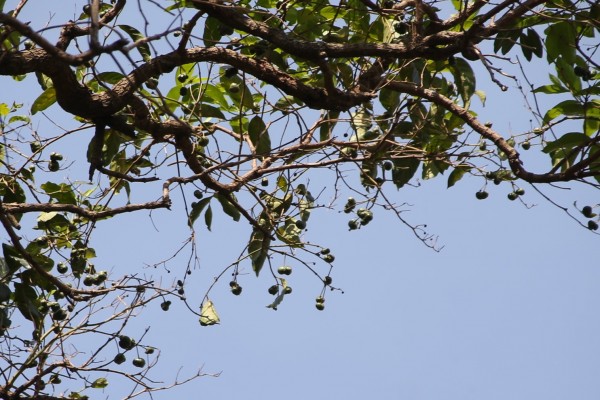
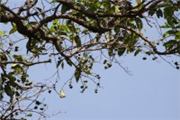
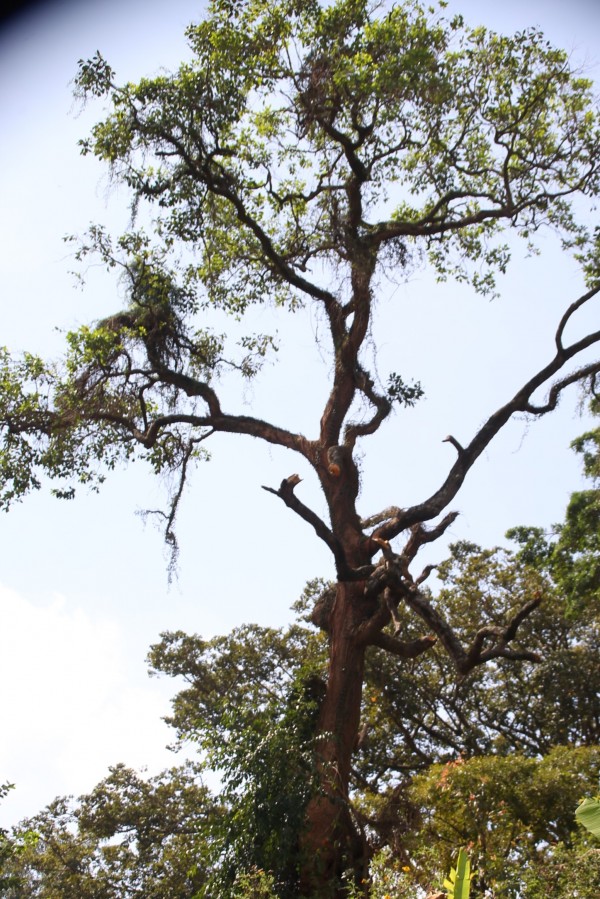
A small tree to 12 m high, the branchlets hanging down with many curves and bends; the bole often crooked, thick branches and a dense shady crown.
BARK: smooth and grey, branches corky, sometimes purple, often 4-sided.
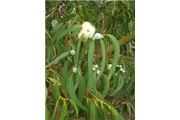
LEAVES: opposite and shiny, about 13 cm long to 18 cm) with 7-10 main side veins each side of the midrib all quite yellow, tip shortly pointed, base wide to a 1 cm stalk. Leafy stipules at nodes of young shoots are large and rounded about 1.5 cm across and 2 cm long (soon falling). Hairs in vein axils below.
FLOWERS: fragrant, white, 1-3 in leaf axils, about 2.5 cm long.
FRUIT: deeply lobed to 2.0 cm, black when ripe, containing the seeds.
Uses
Medicine: the root, bark and leaves. http://tropical.theferns.info/viewtropical.php id=Morinda+lucida
The wood yields yellow to red dyes and the root bark is used to dye textiles into scarlet red.
Edible: bitter-tasting roots are used as flavouring for food and alcoholic beverages. http://tropical.theferns.info/viewtropical.php id=Morinda+lucida
The roots can be used as chewing sticks.
The leaves are used for cleaning and scouring items such as calabashes.
The wood is used for construction, mining props, furniture, canoes, poles etc.
The wood is used for fuel and is excellent for making charcoal.
Ecology
Brimstone tree is indigenous to Uganda. A small tree, sometimes shrubby, and light demanding. In Uganda it grows in secondary scrub, in thickets on termite mounds and at forest margins. Common in thickets and forests near the shores of Lake Victoria. In Kampala, Brimstone tree can be found within Uganda Golf course club, Makerere university, Kitante courts, along Upper Kololo terrace, Acacia avenue among other places.
Management
Lopping, pollarding.
Tree gallery
.jpg)