Livistona chinensis
Chinese fan palm, Fountain palm
Description
Livistona chinensis is an evergreen, fan leaved, solitary-stemmed palm tree growing up to 15 meters tall. The unbranched stem can be 20 - 30cm in diameter. Petioles of juvenile palms are spiny, but have few or no spines in adult palms. Because of its gracefully drooping leaf segment tips, this species is sometimes called the “fountain palm”. Young specimens are slow to form a trunk, which has led to the unfortunate practice of planting these palms close together as a ground cover. Eventually, most of those closely planted palms will have to be removed to accommodate their 10 to 12-foot spread.
BARK: brown trunk, grow mostly upright and will not droop; showy trunk; should be grown with a single leader; no thorns.
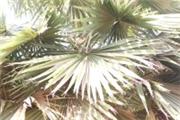
LEAVES: fan-shaped, costapalmate leaves can be 3 to 4 feet across and up to 6 feet long, star shaped leaves arranged in a spiral form and have entire margins, deeply divided into about 75 segments that droop downward that portray an effect of a fountain. Petioles of juvenile palms are spiny, but have few or no spines in adult palms.
FLOWERS: white, inconspicuous and not showy.Flower stalks up to 6 feet long arise from within the crown.
FRUIT: black to blue, round and 5 to 1 inch; <0.5 inch in length.
Uses
An ornamental. It's good for buffer strips around parking lots or for median strip plantings in the highway; near a deck or patio.
Leaves are used for making fans, manufacturing rain hats, coats, and brooms.
Fibers extracted from the sheath and the petiole of the leaves are made into cordage.
Ecology
Chinese fan palm is native to southern Japan, Taiwan the Ryukyu Islands southeastern China and Hainan. It is naturalized in South Africa, Mauritius, Reunion, Andaman Islands, Java, New Caledonia, Micronesia, Hawaii, Florida, Bermunda, Puerto Rico and the Dominican Republic. A plant mainly of the subtropics that prefers a sunny, moist position, but it is a tough, easy to grow palm, that is tolerant of a wide range of conditions. In Kampala, Chinese fan palm can be found at Kitante courts, Nyonyi gardens, along Kintu road, Prince Charles drive among other places.
Management
The Chinese fan palm is relatively slow growing. Needs little pruning to develop a strong structure because it does self-cleaning of old leaves. Regular fertilization with a controlled release 8-2-12 palm maintenance fertilizer will gradually eliminate orange-yellow discoloration and prevent its recurrence. It should be fertilized two or three times during the year. Plants should be watered during dry spells and will benefit from an organic mulch. Completely dead leaves at the bottom of the crown will tightly persist for a year or longer before falling and will have to be cut off manually. The splitting of Chinese fan palm crowns caused by heavy fruit stalks can be prevented by removing the flower stalks prior to fruit development.
Tree gallery
.jpg)