Leucaena leucocephala
Leucaena, Jumpy-bean, Wild tamarind, Lead tree, White popinac, White lead-tree,Horse tamarind
Description
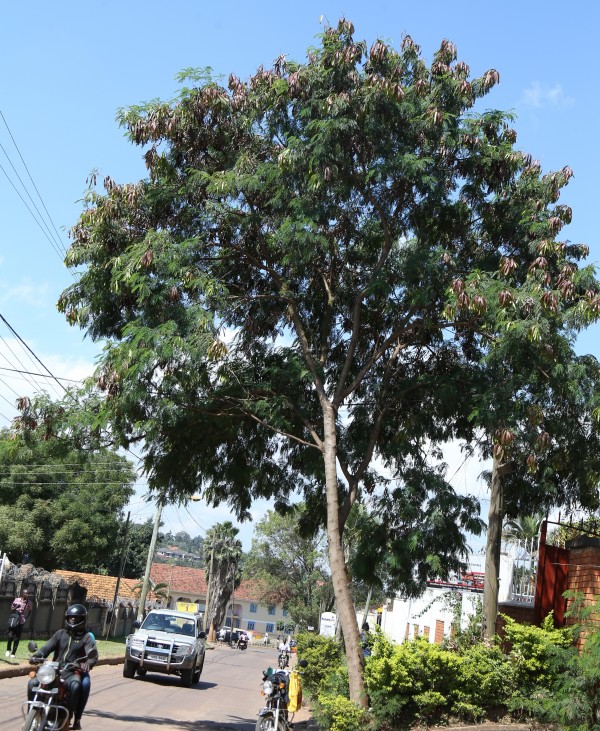
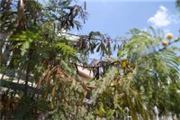
An evergreen shrub or tree 5-20 m, depending on the variety, medium leafy canopy, develops a deep tap-root even as a seedling.
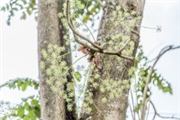
BARK: Young branches smooth, grey-brown, slash salmon pink, darker grey-brown and rougher with shallow, rusty orange-brown vertical fissures and deep red inner bark on older branches and bole.
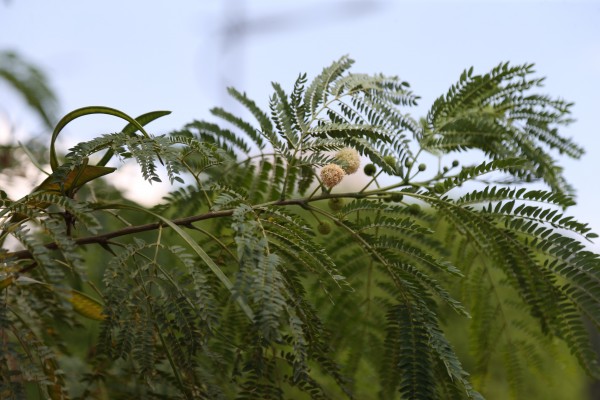
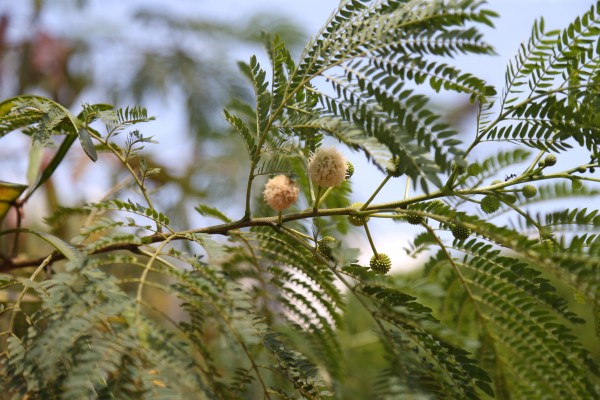
LEAVES: compound alternate with many leaflets, each thin and pointed to 1.5 cm. Leaves and leaflets fold up with heat, cold or lack of water. There is a conspicuous round mark on the leaf stalk just before the leaflets.
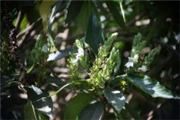
FLOWERS: white, round heads about 2 cm across on a long stalk from the leaf axil .
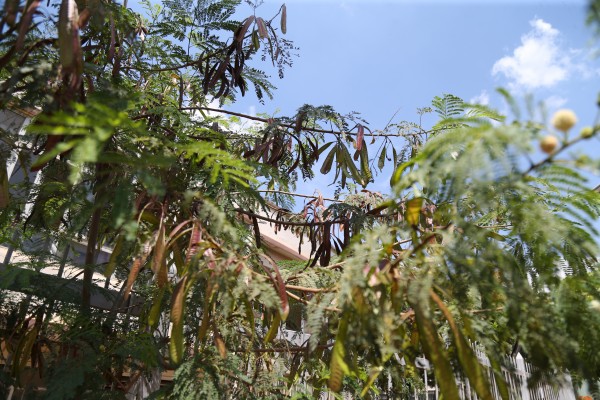
FRUIT: numerous bunches of thin, dry pods 10-15 cm, persisting on the tree, releasing 12-25 hard, shiny brown seeds.
Uses
Medicine: seeds, roots and bark. http://tropical.theferns.info/viewtropical.php id=Leucaena+leucocephala
Agroforestry: used in re-reforestation projects, used as a live fence, firebreak, used as a shade plant for coffee crops, the aggressive taproot system helps break up compacted subsoil layers, improving the penetration of moisture into the soil and decreasing surface runoff, used for the production of green manure in alley-cropping systems, fixes nitrogen in the soil, leaves are source of fodder to the animals, provides bee forage (apiculture).
Edible: seeds can also be prepared as a coffee substitute, young leaves, pods and flower buds can be eaten raw, steamed, in soups, with rice or mixed with chillies and other spices, unripe seeds are mixed with grated coconut wrapped in banana leaves and cooked, mature seeds but not dried are eaten raw or cooked as a delicacy, edible gum obtained from the plant is used in sauces. http://tropical.theferns.info/viewtropical.php id=Leucaena+leucocephala
Gum from the stems under ill-defined conditions of injury and disease or from sterile hybrids, especially Leucaena leucocephala x Leucaena esculenta has been analysed and found similar to gum arabic, and of potential commercial value.
The tree is a source of tannin or dyestuff. Red, brown and black dyes are extracted from the pods, leaves and bark.
Provides poles that are used to prop bananas and as a support for yams, pepper and other vines.
The wood is commonly pulped for its fibre, used to make paper.
Provides firewood.and makes excellent charcoal.
Ground wood can be added to fuel oil for diesel engines thus having no harmful agents in the ash.
An ornamental tree.
The dried seeds are widely used for ornamentation.
Ecology
Leucaena is native to Central America. Widely introduced in the tropics over the last 100 years, reaching Africa in 1950. In Uganda, it was introduced in tea plantations and as a host for the vanilla orchid. Later it was planted among other crops as a nitrogen-fixing shrub. Unfortunately, it now suffers from attack by the Leucaena psyllid, Heteropsylla cubana . In Kampala, Leucaena can be found within Makerere university, Uganda Golf course club, along Haji Musa Kasule road, Sezibwa road among other places.
Management
Very fast growing; lopping, pollarding, pruning.
It coppices well.
Tree gallery