Eucalyptus foelscheana
Broad-leaved bloodwood, Fan-leaved bloodwood, Corymbia, Smooth-barked Bloodwood, Broad-leaved Bloodwood, Bloodwood
Description
A tree up to 10 m tall forming a lignotuber. It is dry season decidious.
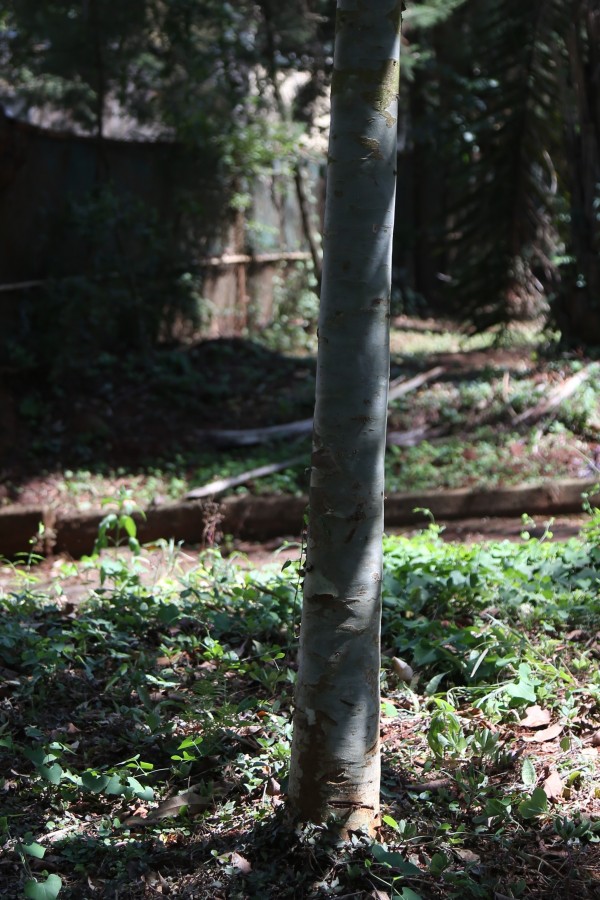
BARK: brown to grey or reddish, variably extending over the lower trunk, sometimes the whole trunk and occasionally the larger limbs, shedding in flakes above to show smooth white to cream and grey.
LEAVES: Juvenile leaves always petiolate, opposite to sub-opposite or alternate, very large, orbicular to broadly ovate, base truncate and sometimes uneven on either side of the petiole, apex usually rounded and apiculate, rarely emarginate, margin usually coarsely crenulate, undulate, dull, green, smooth. Adult leaves are predominantly alternate, sometimes a few sub-opposite to opposite pairs present, blade usually broadly ovate to broadly lanceolate, base truncate to rounded, tapering, or sometimes uneven on either side of the petiole, margin entire, apex rounded and apiculate or pointed, concolorous, dull, green, smooth, side-veins at greater than 45° to midrib (penniveined), reticulation very dense, intramarginal vein apparently absent
FLOWERS: Mature buds obovoid to pyriform, 0.9–1.4 cm long, 0.7–0.9 cm wide, smooth, scar absent (both opercula shed together at flowering)
FRUITS: pedicellate (pedicels 0.3–1.7 cm long), urceolate with a vertical neck that is flared or not flared at the rim, smooth, disc descending vertically or sometimes obliquely when the rim is flared, valves 4, enclosed.
Ecology
A small tree found in the monsoonal Top End of the Northern Territory, from Darwin south to Katherine and also on Melville lsland. Locally abundant, it is often a dominant of savannah woodlands on sandy to gravelly soils, on plains, gentle slopes and footslopes to escarpments. In Kampala, this tree can be found in Kololo precinct.
Tree gallery
.jpg)