Erythrina indica
Indian coral tree, Coral tree
Description
Erythrina indica is a medium-sized, spiny, deciduous tree normally growing to 6-9 m (occasionally 28 m) tall and 60 cm diameter. Young stems and branches are thickly armed with stout conical spines up to 8 mm long, which fall off after 2-4 years; rarely, a few spines persist and are retained with the corky bark.
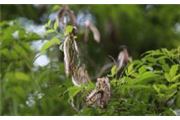
BARK: smooth and green when young, exfoliating in papery flakes, becoming thick, corky and deeply fissured with age.
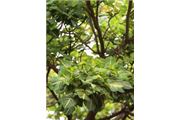
LEAVES: trifoliate, alternate, bright emerald-green, on long petioles 6-15 cm, rachis 5-30 cm long, prickly; leaflets smooth, shiny, broader than long, 8-20 by 5-15 cm, ovate to acuminate with an obtusely pointed end. Leaf petiole and rachis are spiny.
FLOWERS: in bright pink to scarlet erect terminal racemes 15-20 cm long; stamens slightly protruding from the flower.
FRUIT: cylindrical torulose pod, green, turning black and wrinkly as they ripen, thin-walled and constricted around the seeds. There are 1-8 smooth, oblong, dark red to almost black seeds per pod.
Uses
Edible: The new leaves are eaten in curries. http://www.worldagroforestry.org/treedb/AFTPDFS/Erythrina_indica.PDF
The bark is stringy and provides a strong fiber that is used in rope making.
Medicine: bark, and leaves. http://www.worldagroforestry.org/treedb/AFTPDFS/Erythrina_indica.PDF
A red dye is extracted from its flowers.
Provides timber.
Agroforestry: provides shade mostly in cacao and coffee plantations, provides green manure and mulch after pruning, can be used as support for pepper and grape vines, by virtue of its quick growth and suitable bark, acts as a wind break,can be planted as a live hedge, used as livestock fodder when lopped as it is rich in nitrogen (4% of dry weight).
An ornamental tree.
The leaves can be used to wrap fermented meat.
The wood is used to construct outriggers and fishnet floats, packing boxes, picture frames, and toys, but other timbers are much for suitable for this purpose.
Ecology
E. indica is indigenous to the low-elevation deciduous forests of South Asia, found widely scattered throughout the region on plains and undulating terrain up to about 750 m elevation. The tree occurs in a wide range of soils frequently on deep alluvial loams, silts and clays. On gravelly skeletal soils, its growth is normally stunted. It is somewhat frost-sensitive, tender shoots dying back but quickly re-grows under favorable conditions. Preferred rainfall is in the range 500-1500 mm annually; survives with less when planted along water courses or irrigation channels. In Kampala, Indian coral tree can be found along Speke road, Owen road among other places.
Management
Fast growing tree. Pruning and pollarding should be done.
Tree gallery
.jpg)
.jpg)
.jpg)