
Cynometra alexandrei
Uganda iron wood
Kwamba: Kahimbi Runyankore: Muhindi Runyoro: Muhimbi.
Description
An un-mistakable evergreen tree, 10-50 m, to a spreading rather flat-topped crown. Many large buttresses, thin and plank-like, almost triangular, often extending along the ground around the tree like ribbons. The bole is short, rough or twisted, the branches arising low down .
BARK: quite thin, smooth, grey-brown, flaking characteristically into irregular sheets (large or small. Branchlets roughly hairy.
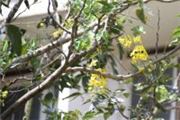
LEAVES: pinnate, usually only 2 pairs of dark green, smooth leaflets (or 3), on a stalk about 3 cm, grooved almost winged, leaflets long oval about 6 cm (1-10 cm), narrowed to a pointed tip, the upper pair much larger than the lower pair.
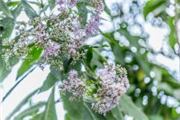
FLOWERS: white (pink), very fragrant, densely crowded in heads 2-6 cm on jointed stalks.
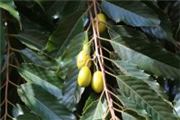
FRUIT: smooth flat pods, 5-10 cm, each round or pointed, 3-4 flat circular seeds.
Uses
Agro forestry: tree is used for soil conservation, provides forage.
The wood is used for fuel and to make charcoal.
An ornamental tree.
Provides poles.
The bark serves to make baskets and is also used as an arrow poison.
The wood is used for heavy construction, heavy flooring, ship building, vehicle bodies, mine props, railway sleepers, furniture, cabinet work, sporting goods, toys, novelties, agricultural implements, tool handles, draining boards, carving and turnery.
Caterpillars feeding on the leaves are collected in DR Congo to serve as bait for fishing.
Medicine: bark. https://www.prota4u.org/database/protav8.asp g=pe&p=Cynometra+alexandri+C.H.Wright
Ecology
Uganda iron wood is native to Uganda. There are 50-60 pantropical rain-forest Cynometra species, including several in East Africa. Forests of Uganda ironwood are confined to the Western Rift Valley in Uganda. It is the dominant tree in the mature (climax) Budongo Forest, found generally at lower altitudes, 1,000-1,200 m, e.g. in Budongo, Kibale, Maramagambo and Kasyoha-Kitome as well as Mangiro Forests. Perhaps there is a larger standing volume of this species than of any other timber tree in Uganda. . In Kampala, Uganda iron wood can be found within Makerere university at Mitchell hall among other places.
Management
The tree is a slow grower and requires shade until established. Coppicing, pollarding.
Tree gallery
.jpg)
.JPG)