Bambusa vulgaris
Common bamboo, Golden bamboo
Description
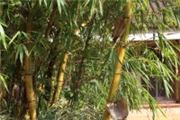
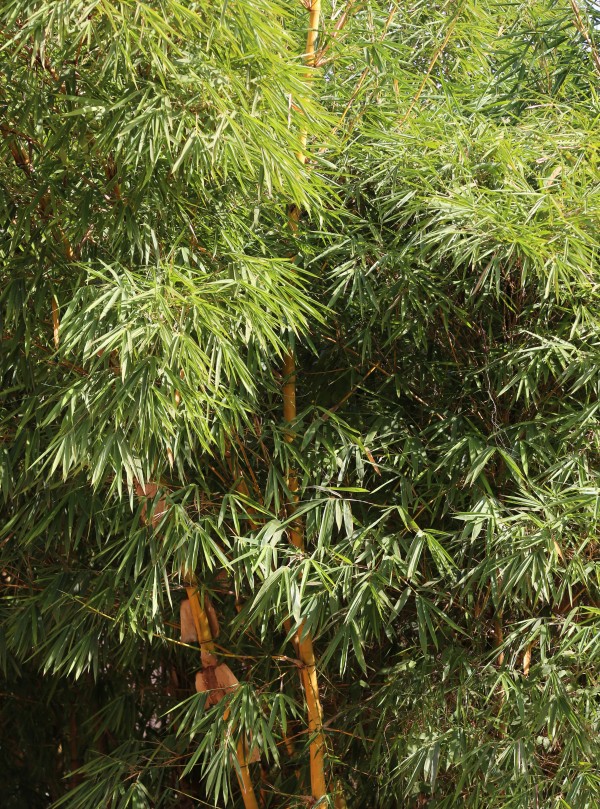
Common bamboo is an erect, evergreen, clump-forming bamboo growing 15 - 20 meters tall. The thin-walled, hollow canes are 40 - 120mm in diameter with internodes 20 - 45cm long. It forms moderately loose clumps and has no thorns.
BARK: lemon-yellow culms (stems) with green stripes, culms are basally straight or flexuose (bent alternately in different directions), drooping at the tips. Culm walls are slightly thick. Nodes are slightly inflated. Internodes are 20–45 centimeters. Several branches develop from mid-culm nodes and above.
LEAVES: dark green, deciduous with dense pubescence, alternate, simple; stem leaves with sheath more or less broadly triangular, covered with appressed black or brown hairs, auricles 2, 0.5–2 cm long, with pale brown bristles 3–8 mm long along the edges, ligule 3–8 mm long, slightly toothed, blade broadly triangular, branch leaves with sheath 6–10 cm long, hairy outside, auricles rounded, 0.5–1.5 mm long, with a few bristles 1–3 mm long, ligule 0.5–1.5 mm long, blade linear-lanceolate, base rounded, apex acuminate, margin scabrous, glabrous,leaf blades are narrowly lanceolate.
FLOWERS: not common, large panicle 2–3 m long, on leafless branches, bearing small groups of spikelets at the nodes.
FRUITS: rare due to low pollen viability caused by irregular meiosis.
Uses
Edible: a decoction of the growing point of the plant, mixed with the roots of Job's tears ( Coix lacryma-jobi ) gives a refreshing drink, young shootscan be cooked and eaten with rice. http://tropical.theferns.info/viewtropical.php id=Bambusa+vulgaris
Medicine: shoots, stems, bark, leaves, sap. http://tropical.theferns.info/viewtropical.php id=Bambusa+vulgaris
Agroforestry: Used for shelterbelts and erosion control on sloping ground and stream banks, can be planted as a barrier and marker along boundaries.
The split stems are used for making brooms, fences, roofs, roof tiles, baskets etc.
The acrid smoke produced from burning the stem is used as a mosquito repellent.
The stems serve as poles to support banana plants.
The canes are used for light construction, fences, tool handles, handicrafts, irrigation pipes, lattices, bridges, housing, furniture, boat masts etc.
They are a good source of pulp for making paper.
The canes are used for fuel.
An ornamental tree.
Ecology
Common bamboo is native to tropical Asia. It is the most widely cultivated bamboo throughout the tropics and subtropics, but is also found spontaneously or naturalized on river banks, roadsides, wastelands and open ground, generally at low altitudes. In cultivation it grows very vigorous on moist soil and under humid conditions but tolerates a wide range of climatic conditions and soil types up to 1,200 m altitude. In Kampala, Common bamboo can be found within Makerere university, at Tufnell, Kyadondo road among other places.
Management
Weeding is recommended in the first 2–3 years after planting, 2–3 times per year, preferably during the rainy season. Irrigation and fertilizer application considerably improve growth and yield.
Tree gallery
.JPG)
.JPG)