Zanthoxylum gilletii (Fagara macrophylla)
East African satin wood
Kwamba: Kitututie Luganda: Munyenye Lugishu: Shukuma Rukiga: Omushaga Rukonjo: Nyakabonde Runyankore: Mulemankobe Runyoro: Ntaleyerungu Rutoro: Mutatembwa Sebei: Sagawat.
Description
A deciduous forest tree 10-35 m with a straight trunk and clear bole up to 15 m, diameter 30-90 cm, crown spreading; unarmedor with conical woody knobs,1-3 cm, often inconspicuous on old trees. Young stems armed with straight or recurved spines.
BARK: smooth, grey, with spiny woody cones.
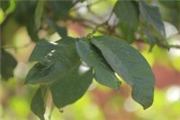
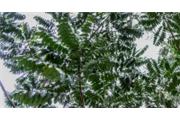
LEAVES: interminal clusters, leaf stalks and branchlets with straight prickles to 1 cm, 6-13 pairs stiff leaflets plus one terminal one, 14-30 cm long, the tip suddenly pointed, base one-sided or rounded , gland dots numerous but small, sometimes a few prickles on the midrib, 8-14 lateral veins, leaf edge smooth, occasionally round toothed.
FLOWERS: cream-white, male and female, small in terminal pyramid clusters 20-30 cm long.
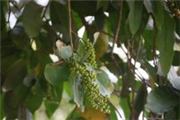
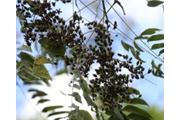
FRUIT: rounded and red,4-6 mm, with one shiny black oily seed tasting like peppermint.
Uses
Edible: Young shoots, leaves, seed. http://tropical.theferns.info/viewtropical.php id=Zanthoxylum+gilletii
Medicine: Stem and root bark, leaves, leaf sap. http://tropical.theferns.info/viewtropical.php id=Zanthoxylum+gilletii
The stem protuberances are used as plugs.
The seed coat contains an essential oil.
The roots are used as chewing sticks to clean the teeth.
The wood is used for construction in house building, for flooring, joinery, interior trim, paneling, doors, shipbuilding, vehicle bodies, furniture, cabinetwork, mine props, railway sleepers, handles, ladders, sporting goods, agricultural implements, drums, toys, novelties, boxes, crates, turnery, veneer and plywood.
The wood makes good quality firewood and used for charcoal production.
An ornamental tree.
Ecology
A large rain-forest tree from West Africa into the Sudan, South to Angola and throughout East Africa where it has been used in the timber trade. In Uganda, it grows in tropical rain forests, especially in lower- and medium-altitude forests on Mt. Elgon and the Ruwenzori Mountains as well as in Kasyoha-Kitomi, Kalinzu, Kibale and the Impenetrable (Bwindi) Forests. Sparingly found in lowland forests of Budongo and Mabira. In Kampala, this tree can be found at Makerere University among other places.
Management
Fairly quick growing.
Tree gallery