
Terminalia ivorensis
Ivory Coast almond, Black afara, Black barked Terminalia, black bark, yellow Terminalia, satinwood, shingle wood
Description
A semi-deciduous forest tree reaching 40 m or more with a bole to 1 m and small buttresses. Branches are clearly in whorls andhorizontal when young. In young trees, the branches are whorled; deciduous, young shoots and foliage falling a few years after initial growth, leaving sockets to mark their original position on the bole. The bole is very straight with small buttresses and is sometimes also fluted. Mature trees are very flat topped with a wide horizontal canopy of evenly distributed foliage arising from the apex of the straight bole
BARK: smooth and light grey to dark brown when young and on branchlets; in mature trees often blackish, with deep longitudinal fissures. The bark flakes off in long thin strips.
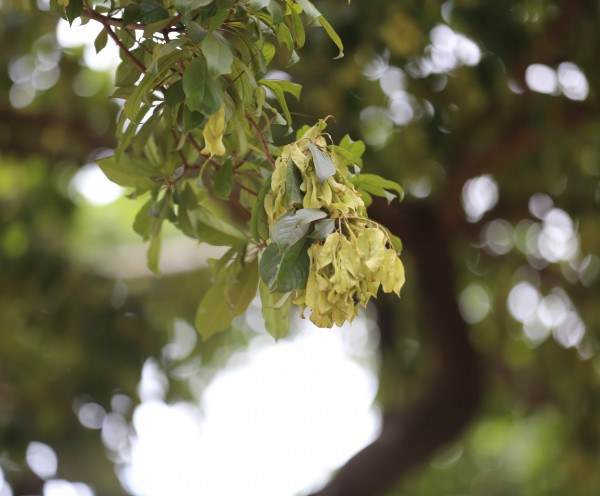
LEAVES: simple and whorled, oval and blunttipped with orange-brown hairs below and on veins above, alsoon the short stalk,6-7 pairs widely spaced veins, clear below.
FLOWERS: small in heads. Flowers in axillary spikes 7.6-10.2 cm long with bisexual flowers nearly to the apex. The lower receptacle is densely tomentose, the upper receptacle less so.
FRUIT: dry and brown, two-winged oblong to about 7 cm long and 2 cm across, oval seed in thecenter, 1.5 cm. When ripe it is reddish-brown and woody.
Uses
Provides useful timber that is valued for light construction, door and window frames, joinery, fine carpentry, furniture, cabinet work, veneer and plywood. It is suitable for flooring, interior trim, vehicle bodies, sporting goods, boxes, crates, matches, turnery, hardboard, particle board and pulpwood. It is used locally for house construction, planks, fencing posts, dug-out canoes, drums and mortars.
The wood is used for fuel and is highly valued for making charcoal.
Medicine: bark, leaf sap, and roots. http://tropical.theferns.info/viewtropical.php id=Terminalia+ivorensis , https://www.prota4u.org/database/protav8.asp g=pe&p=Terminalia+ivorensis+A.Chev
Agroforestry: can be used as a shade tree in cocoa, banana and coffee plantations. It can also provide shade to the public.
It is planted as an ornamental tree or road-side tree.
A yellow dye is present in the bark and wood; it is used traditionally to dye clothes and fibers for basketry.
Ecology
Ivory Coast almond is native to West Africa. Many Terminalia are important West African timber trees, including this species. It is exported, from Nigeria for example, under the trade name Idigbo. It is an emergent in the upper storey of seasonal forest but sometimes loses its vertical-growing leader, resulting in considerable variation in height of mature trees. Terminalia ivorensis can withstand short periods of inundation, though it is usually sensitive to waterlogging. For optimum development, T. ivorensis requires high, well-distributed rainfall. It is very vulnerable to fire. Introduced into Uganda in the early1960s, it was planted in the Buto-Buvuma and Semliki forests. The trees have now grown to commercial timber size and seeds can be collected from mature trees. In Kampala, Terminalia ivorensis can be found within Uganda Golf course club, along Lower Kololo terrace, Mackenzie Vale road among other places.
Management
Pruning is not required since later branches die leaving a clean trunk. It is a fast growing tree. The tree coppices well even to an advanced age, but it is normally managed on a coppice rotation.
Tree gallery
.jpg)
.jpg)
.jpg)