Entandrophragma cylindricum
Sapele mahogany, Sapelli mahogany, West African cedar, Scented mahogany
Luganda: Muyovu Runyoro: Muyovu Rutoro: Muyovu.
Description
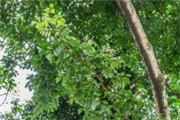
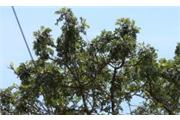
A deciduous forest tree to 55 m or more, the trunk tall and straight, often clear 25-30 m, the rounded crown medium sized. Buttresses alone up to 3 m. The trunk may be 1 m or more across.
BARK: brown and smooth at first, turning grey and flaking towards the base in irregular scales on mature trees.
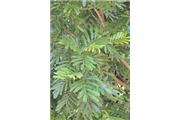
LEAVES: pinnate on stalks to 30 cm, tufted at the ends of branches, 11-19 leaflets, often alternate, lowest pairs oval, others long oval up to 12 cm long, tip pointed, 6-9 lateral veins and a close network of veins on both surfaces.
FLOWERS: tiny, white on a branched stalk to 25 cm.
FRUIT: a brown woody capsule about 14 cm, rounded at the tip, breaking into 5 parts. The capsule opens first at the tip, then the base and pieces fall away one at a time. Winged seeds about 8 cm long are attached alternately left and right to the central column.
Uses
Medicine: the bark, heartwood. http://tropical.theferns.info/viewtropical.php id=Entandrophragma+cylindricum
Bark extracts have been used to protect stored maize from pests.
The tannin present in the bark has been used experimentally to produce tannin-formaldehyde resin, which can be used as lacquer.
The seeds contain about 45% oil that can be used in the industrial production of nylon-11.
An essential oil is obtained from the bark.
The wood is highly valued for flooring, interior joinery, interior trim, paneling, stairs, high class furniture, cabinet work, musical instruments, carvings, ship building, veneer and plywood. It is suitable for construction, vehicle bodies, toys, novelties, boxes, crates and turnery.
The bole is traditionally used for dug-out canoes.
The wood can be used as firewood and for charcoal production.
The tree is planted as a roadside tree and ornamental shade tree.
Ecology
Sapele mahogany is indigenous to Uganda. This tree is an important timber tree occurring widely in tropical Africa from Sierra Leone to Uganda and Zaire. In Uganda is grows in mixed to climax tropical rain forest, in thickets and in gallery forest in Budongo, Bugoma, Mabira and West Mengo Forests, 1,100-1,500 m. In Kampala, Sapele mahogany can be found alongUpper Kololo terrace among other places.
Management
In the forest, seedlings germinate and survive well, but when planting seedlings in open areas, tending and shade are required until established. Plant under nurse trees wherever possible.
Tree gallery
.jpg)
.jpg)
.jpg)