Calliandra calothyrsus
Calliandra, Red calliandra
Description
A large multi-stemmed shrub, 4-6 m, branches spreading, maximum stem diameter in good conditions 20 cm. The canopy can be quite dense.
BARK: grey-brown, smooth.
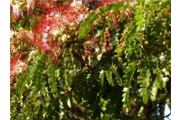
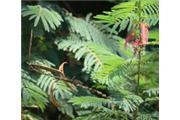
LEAVES: compound, dark green, folding at night, shed in a long dry season.
FLOWERS : showy red "brushes" of many long shiny stamens, very many on the stalk.
FRUIT: a pod about 10 cm long which breaks open, each half curling back to set free up to 15 seeds.
Uses
Agroforestry: can be used to rehabilitate erosion-prone areas and to recover land exhausted by agriculture, can be used as a nurse tree for partially shade-tolerant timber trees, can be used as a windbreak, fixes atmospheric nitrogen, adds green manure, used in alley-cropping systems, suitable for hedgerow boundaries, can be used in intercropping, flowers provide a rich source of nectar for bees, leaves and twigs provide fodder to the animals.
The wood can be used for small carpentry work, implement handles, frames etc., and provides poles.
The wood is suitable as a smoking fuel for the production of smoked sheet rubber.
A good firewood species and the wood is also used to make charcoal.
The wood is suitable for pulp and papermaking.
An ornamental and shade tree.
Ecology
Native to Central America. Calliandra species have long been popular in the tropics as ornamentals due to their red flower heads. This species has been planted for forestry purposes, especially as quick-growing fuelwood. Brought very recently to Uganda; does well in a variety of soils, including acidic ones, 1,500-2,000 m. Performs better at higher altitudes than Leucaena and tolerates several months of drought but does best with high rainfall. It does not tolerate waterlogging. In Kampala, Calliandra can be found within Uganda Golf Course Club, Makerere II zone C, Kitante courts among other places.
Management
Very fast growing on good sites: lopping, coppicing.
Tree gallery
.jpg)
.jpg)
.jpg)
.jpg)